| PhariseeChurch |
| . |
| . |
| From How to Survive in the Pharisee Church This is Chapter 18 All relationships need rules. This is true of families, marriages, workplaces, communities, nations, and even our everyday friendships. Without rules you get chaos, misunderstandings, and, worse than that, exploitation and manipulation. Marriage is a good example. No woman wants her husband turning to her after five years of marriage and saying, “But I never thought you would expect me to remain faithful! That was never a part of the deal!” So when you marry you make a contract. It lays out the rules, like: “forsaking all others till death do us part.” Contracts are a routine part of our daily lives. When you start a new job, you get a contract. It tells you two things—what your employer expects from you, and what you can expect from your employer. That way you both know where you stand. It’s the same with God. God likes contracts and uses them all the time. The Old Testament is full of contracts between God and various individuals or groups. Abraham, Moses, and David all had them, sometimes for themselves and sometimes held by them as leaders on behalf of the community. Apart from these well-known ones, there were many lesser ones as well. When we become Christians, we enter into a contract with God. This is given to us for the same reasons as any other contract. It defines the relationship, tells us the rules, gives us security, and avoids misunderstandings. It’s not always fully understood that Christian conversion involves the entering into of a contractual relationship with God. One reason for this is that Christians tend not to use the word “contract” with its worldly and materialistic connotations. More often they say “covenant,” which is simply an old-fashioned word meaning the same thing. Although we have a contract with God, we don’t have a contract with the church—at least not one given by God (some churches like to impose their own contracts, but that’ s different). It might save us a lot of trouble, but that’s not God’s way. He gives us a few broad guidelines and then leaves us to get on and work out our own structures and relationships according to the one overriding principle of love. God is not a controlling personality, and he has no interest in imposing specific structures on us. This can be inconvenient and uncomfortable for us at times, but it’s the way he wants it. This doesn’t mean our contract with God is of no help in defining our relationship with the church. On the contrary, it’s actually very useful. This is because many of the issues here—as in all relationships—revolve around the question of boundaries, or spheres of responsibility. The boundary system involves three parties—me, God, and the church. If I can understand God’s boundaries with me and with the church, and if I can understand my boundary with God, then correct positioning of my boundary with the church becomes much easier. Our contract with God helps us to do this, so we need to have a clear understanding of what it says. OUR CONTRACT WITH GOD The contract we enter into with God when we become Christians is usually referred to as the New Covenant, though New Contract would do equally well and probably convey the meaning better. It’s not actually new at all. It’s about 2,700 years old, but back then it was new. It’s the most recent of God’s contracts with his people, and it supersedes and replaces all the ones that went before. It’s also the final one. There will be no more contracts after this one, since this is an everlasting one that has no need of replacement. The complete text of this New Contract is found twice in the Bible, once in the Old Testament and once in the New. This is how it goes: “The days are surely coming,” says the Lord, “when I will establish a new covenant with the house of Israel and with the house of Judah; not like the covenant that I made with their ancestors, on the day when I took them by the hand to lead them out of the land of Egypt; for they did not continue in my covenant, and so I had no concern for them,” says the Lord. “This is the covenant that I will make with the house of Israel after those days,” says the Lord: “I will put my laws in their minds, and write them on their hearts, and I will be their God, and they shall be my people. And they shall not teach one another or say to each other, ‘Know the Lord,’ for they shall all know me, from the least of them to the greatest. For I will be merciful toward their iniquities, and I will remember their sins no more.” The New Contract starts with the words, “The days are surely coming, when . . .” It was written in the future tense, looking forward to a time that had not yet arrived. The prophecy was given to the prophet Jeremiah in the seventh century BC, and he wrote it down. It spoke of a time in the future when the old contract, given to Moses on Mount Sinai (which even in Jeremiah’s time had been in use for more than 800 years), would be replaced by this new one. The timing of this future event would have been a mystery to Jeremiah and his contemporaries, but to us it has been made known. The letter to the Hebrews tells us that Jesus Christ himself is the mediator of the New Contract, and that his resurrection ushers in the new era. Thus, the New Contract is the contract of the New Testament, and when we become Christians this is the contract that we enter into with God. It defines much of our subsequent relationship with him, so we need to understand it well. The contract falls neatly into four sections, with a short preamble. We will look at these sections one by one. For clarity, we take them in a different order from that found in the original document. We are going to see that the contract is not an evenly balanced one. Like all God’s contracts, it’s very one-sided. It’s heavily weighted . . . in our favour! God is giving us a lot more than we are giving him. We shouldn’t be surprised by this. There’s always an imbalance in our relationship with God. He has far more to give to us than we have to give to him—we bring little or nothing to the game. If we think we can have an equal, balanced relationship with God, then we fundamentally misunderstand our position. The preamble deals with the essential question of who, exactly, are the “signatories” of this contract. We are told that it is between God on the one side and the houses of Israel and Judah on the other. In this context, house refers to the various original tribes of the Jewish people and their subsequent mutations. These tribes had started as large extended families composed of blood relatives. Over time, the composition changed as outsiders were adopted in, some tribes were wiped out completely, and others fused into larger blocks. Later on, in the New Testament era, the change was accelerated and more dramatic. Huge numbers of Gentile Christians were grafted in. Many of the original tribal members opted out. Hebrews makes it clear that the house of Israel and the house of Judah now refer to the family of God in its newer, wider sense—in other words, the Christian church. When we read the contract, we find it includes two distinct types of element. There are “family” elements, describing a corporate contract between God and the whole church as a unit, and there are “individual” elements, describing a personal contract between God and each of us as individuals. We will have to disentangle these two as we go through. 1. “I will be their God . . .” “. . . and they shall be my people,” God says of us. This is the only clause in the whole contract that is reciprocal, in the sense that in return for God’s commitment to us he expects something back. The nature of this return obligation is deliberately left open- ended. God is looking for a family commitment, and this can’t be easily defined in terms of rules and regulations. God is saying, “You are to be a family member, with whatever that may entail.” 2. “I will remember their sins no more” The offer here goes beyond simple forgiveness. There can be degrees of forgiveness. We may say, “Well . . . I forgive you, but I won’t forget. I’m filing it away for future reference in case I want to bring it up again in the future.” That’s human forgiveness. It’s not really forgiveness at all, more a form of probation—forgiveness, but with conditions attached. People do this all the time, but God never does. When God forgives, the slate is wiped clean. It’s unconditional. Our sin is erased from the record and forgotten about. God will never dust it off and use it against us in the future. We may sin again and again, but each time it’s as if it were the first offence. That’s the nature of God’s forgiveness, as expressed in the New Contract. There will be no further accounting. It’s gone, forgotten, finished for all time. 3. “I will put my laws in their minds and write them on their hearts” The first two clauses have shown the generosity of God in our adoption and our forgiveness. Now he takes it to another level. It’s a direct supernatural intervention in our lives, leading to a once and for all moral transformation of our deepest nature. From now on our morality, our understanding of right and wrong, is to be internal, flowing from our hearts, rather than something externally imposed. This goes beyond mere knowledge—it touches our desires and motivations. “I am changing your nature from the inside,” God tells us. “From now on, you will have a nature to think like me. From now on, doing good will come naturally to you. Loving people will come naturally. You won’t need to strive and struggle to do the right things. It will just happen.” Of course, in reality we quickly find that it’s not quite so simple. The old nature is still around, ready to reassert itself and even drown out the new nature completely, if given the chance. Nonetheless, the change has been made. The new nature is now in place and is fused into our deepest selves. With this knowledge, we can relax a bit and see the Christian life in terms of learning to be ourselves (our new selves, that is, not our old selves) rather than of being turned into something that we’re not. We stop striving, and learn to let the new nature flow out from our hearts. 4. “And they shall not teach one another…” This is the final and most revolutionary clause of the contract—though in fact it follows logically from the one before. If God is writing his laws directly into our hearts and minds, where does that leave the role of the teacher? Teachers exist to teach us things that we don’t know. At school we have geography classes to teach us about life in other countries. But if later we get the opportunity to visit those countries for ourselves and see them firsthand, then the lessons become superfluous. We say, “Hey, that teacher missed half of it! I’ve been there myself, and I’ ve seen more than he ever knew!” When we become Christians and come to know God personally, he takes on the role of our private tutor. In our new environment, second-hand knowledge about God is replaced by direct personal encounter with God. This may not necessarily make the teacher entirely redundant (we will return to this in the next chapter), but he is reduced to a supporting capacity, while God himself takes the primary role. That’s the essence of the New Contract. It’s quite a package: Two clauses on what God has done for us, by adopting us and forgiving us; and two clauses on what he has done in us, by giving us a new heart like his own and a direct communication channel for personal instruction. It’s a comprehensive and central statement of what it means to be a Christian, as God sees it. It’s our heritage in God and the basis for how we structure our lives with God. And it’s a key reference point for looking at our relationship with the church. THE NEW CONTRACT AND THE CHURCH As we’ve seen, the contract contains a mixture of individual and community elements. It starts as an agreement between God and his people as a whole, but the emphasis quickly shifts from the community to the individual. All the significant clauses are addressed to us as individuals. It is as individuals that we are to be forgiven, have God’s laws written on our hearts, and be his people. It is as individuals that we are to know God, be known by God, and be tutored by God. This applies to every one of us—to all . . . from the least of them to the greatest. There are no exceptions. There is no place here for “important people” with a special, privileged access to the mind of God, nor for “lesser people” who are depending on those above for knowledge. God says he will deal with each and every one of us on an equal basis. The personal knowledge of God is made available to all of us in equal measure. So where does this leave the church, with its teachers and its hierarchies? To understand the correct balance between God, the individual, and the church, the analogy of the human family is a useful one. It’s also a model that Jesus and Paul used frequently to convey their understanding of the various interrelationships involved. The analogy of the church as a family is simple and straightforward. God is the Father. The rest of us Christians are his children, and brothers and sisters to one another. In comparison to the wisdom and experience of God, we’re obviously rather young children, though clearly there’s a range. For us younger ones, the church institution can then be our nursery or playroom, where we play our games, act our parts, and go through the process of exploration and experimentation that is a necessary part of growing up. Our Father is naturally of the very wisest sort. He doesn’t mollycoddle us, but rather gives us the space we need to fall over a few times, make some mistakes, and learn from our experiences. Within any family group, a dynamic is likely to emerge, in which those who are a bit older take on a guiding role for those who are a bit younger. In that little world, six seems like a lot older than four, even if from an adult perspective none of them know very much of the real world. What little the older ones know, they share with the younger; and as likely as not the four-year-old will look up to the six-year-old with something akin to awe and reverence, such is the perceived depth of his or her knowledge. But when the door opens and the father steps into the room, everything changes. Suddenly, all eyes are on him, the games stop, the play-acting comes to an end, the roles are switched, and we come back to reality—or as much of a reality as our childish eyes are able to understand. Our mentors are revealed for what they really are—other small children, slightly older than us, but children nonetheless. This is the spiritual reality of the Christian church. In God’s eyes, we’re all beginners. That’s all this life is for us, a beginning. What we call spiritual maturity, seen from God’s perspective, is like a six-year-old showing his little sister how he’s finally learned to tie his own shoelaces and giving her a few tips. It’s a wonderful thing to do—but we need to keep it in right balance. Paul tells us that if we think we’ve even learned to stand up, we’re heading for a fall. There’s no harm in our listening to teachers—perhaps they really can help us tie our laces better. But our real tutor is God, and in comparison to him, all human teachers, even the best, are limited, fallible, and often just plain wrong. Applying the family analogy to the story of Elijah, we find there someone who is part of a family unit that has effectively disintegrated. The kids are running wild, out of control. They have disowned the father and barricaded the playroom door to keep him out. He could force his way in, but he won’t do that. He has decided that they’re old enough to take the responsibility, make the decisions, and accept the consequences. Elijah wants no part in it, so God pulls him out and takes him off on his own. It’s a hard and lonely time for him, but his Father’s company is sufficient to see him through, and he grows up quickly. It’s good to have a family, but sometimes you’re better off not having them around the whole time. When families fall apart in conflict and acrimony, it can be very hard on the younger ones. Children blame themselves for conflicts in which they have no real part. If they’re abused, they may assume it’s something they’ve brought on themselves or even deserve. It’s a downside of their natural, instinctive respect for authority. The same thing can happen in church. If we find we don’t fit in, our first reaction may be to blame ourselves. It may be our fault, of course, but equally it may not be. To grow into maturity and fulfill our spiritual potential, we have to grow out of this child-like tendency to self-blame and learn to make more objective and impartial judgments. Sometimes we will have to admit to being wrong, but other times we will be right, and we need to recognize that without apology. The New Contract puts a high value on our individuality and personal uniqueness. My own parents, who were far from perfect, had an irritating tendency to refer to my brother, sisters, and myself as if we had a sort of collective group consciousness, as opposed to being four separate and unique individuals. It was always, “The children, this,” and, “The children, that.” Sometimes I wanted to scream, “Hey, I’m me! I exist! Sure, I’m part of this family, but I have my own attitudes, ideas, and opinions! I’m not just a cog in a machine!” Later on when I joined churches, I found a similar process of identity suppression at work. My unique individuality was always being subordinated to the collective good of the community as a whole. Not surprisingly, I reacted badly to this. God’s approach to his family is very different. He never allows his feeling for the family as a whole to cloud his appreciation of our individuality. Emphasis on the supreme importance and value of the individual is a big part of the legacy of Christianity in Western society—though most people have long forgotten where it came from. It’s clearly enshrined in the New Contract, but it regularly gets lost in church—and particularly, as we’ve seen earlier, in mission-orientated churches with a high premium on quantifiable results. If we rely on a worldly paradigm to build our church, then we may be successful in building an organization, but that organization may be one that has ceased to reflect God’s values. We also deny a central tenet of our contract with God, under which every individual from the least of them to the greatest has an equal, and probably infinite, value. It’s a contract of equality of opportunity and ability. God has given it to us, and we owe it to ourselves to stand by it. When I started my apprenticeship in medicine many years ago, I looked at the senior medical specialists in the hospital where I was training as all-wise, all-knowing, almost God-like figures. I think we all did. Three decades later, I’ve been there and done it for myself, and now I can look back and laugh a little at my earlier naivety. Now I know how very ordinary they can be. My perception was a delusion. It was a normal and entirely natural delusion, one that most of us have experienced at some time in our lives. It may have been a healthy delusion and a necessary delusion. But it was a delusion nonetheless, since the perception did not accurately reflect the reality. I had to grow out of this delusion, just as those men, in their time, had had to grow out of theirs. To spend my career languishing in their shadow would have been to stunt my own development and sell myself short. I had to grow up. Every one of us, in our own process of growing up, has had a day of shocked realization when we had to face the fact that our parents were mere mortals—ordinary, fallible human beings. If we had older brothers or sisters, we may have gone through a similar process with them. When I first became a Christian, I put our “apostle” and some of the senior church members on a pedestal. I truly believed that they were like Moses, that they could practically speak with God face to face. Time and experience again revealed the truth to me. We grow up in our workplaces, we grow up in our families, and we have to grow up in the church. Sadly, it doesn’t always happen. Many church members show no interest in growing up . . . ever. And some pastors are likewise happy to keep their flock in a state of child-like dependency forever. This state of affairs can simply be a reflection of the institutionalized codependency that afflicts so many churches. However, it can also be a reflection of something altogether more sinister. This will become clearer in the next two chapters, as we move on to explore the underlying nature of two fundamental limitations that are intrinsic to that very limited and imperfect instrument known as the Christian Church. |

If I'd known how difficult it was going
to be, I don't think I would ever have
become a Christian, but I didn't so I did,
That was in November 1969.
I've not had too many problems with
God, once I understood what it was
about, but with the church I've had
plenty. Its the community you can't live
within and you can't live without. It
was the struggle to resolve this
paradox that led me to write my book
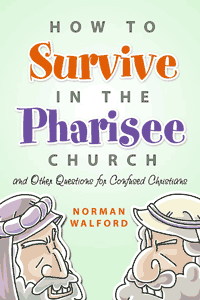
How To Survive in the Pharisee Church
in 2009.
Now in my blog I write about issues of
practical Christianity in general,
including most recently a satirical bent
as in The Chronicles of the Pharisee
Church of St Gregory-the-Try-Harder, a
semi-mythical (but mostly real)
Anglican church on the island of
Singapore, where I live.
to be, I don't think I would ever have
become a Christian, but I didn't so I did,
That was in November 1969.
I've not had too many problems with
God, once I understood what it was
about, but with the church I've had
plenty. Its the community you can't live
within and you can't live without. It
was the struggle to resolve this
paradox that led me to write my book
How To Survive in the Pharisee Church
in 2009.
Now in my blog I write about issues of
practical Christianity in general,
including most recently a satirical bent
as in The Chronicles of the Pharisee
Church of St Gregory-the-Try-Harder, a
semi-mythical (but mostly real)
Anglican church on the island of
Singapore, where I live.